
Aesthetic qualifications are no longer something practitioners consider only later in their career. Clients are more informed than ever. The aesthetics sector faces greater scrutiny. As a result, qualifications now play a central role in how practitioners build trust – with clients, with insurers, and with the wider professional environment they work in.
This article explains why aesthetic qualifications matter, what they offer beyond the certificate, and how to think clearly about choosing the right route.
Why Aesthetic Qualifications Are Becoming More Important
The UK aesthetics sector has grown rapidly. However, until recently, it operated with very few mandatory standards. There was no single requirement governing who could practise or what training they needed. Consequently, quality and safety varied considerably across the market.
That is changing. The UK Government published its response to the 2023 DHSC consultation on licensing non-surgical cosmetic procedures in August 2025. The consultation attracted 11,848 responses. Of these, 55% came from professionals and 41% from members of the public. Furthermore, 82% of the professional respondents were actively providing non-surgical cosmetic treatments at the time.
The government confirmed a new licensing framework. Under this framework, practitioners must be suitably knowledgeable, trained and qualified, hold appropriate indemnity cover, and operate from premises meeting hygiene standards. Therefore, practitioners who already hold structured, recognised qualifications start from a stronger position. Those relying on short courses alone may find the gap harder to close under time pressure.
What Clients Are Really Looking For Before They Book
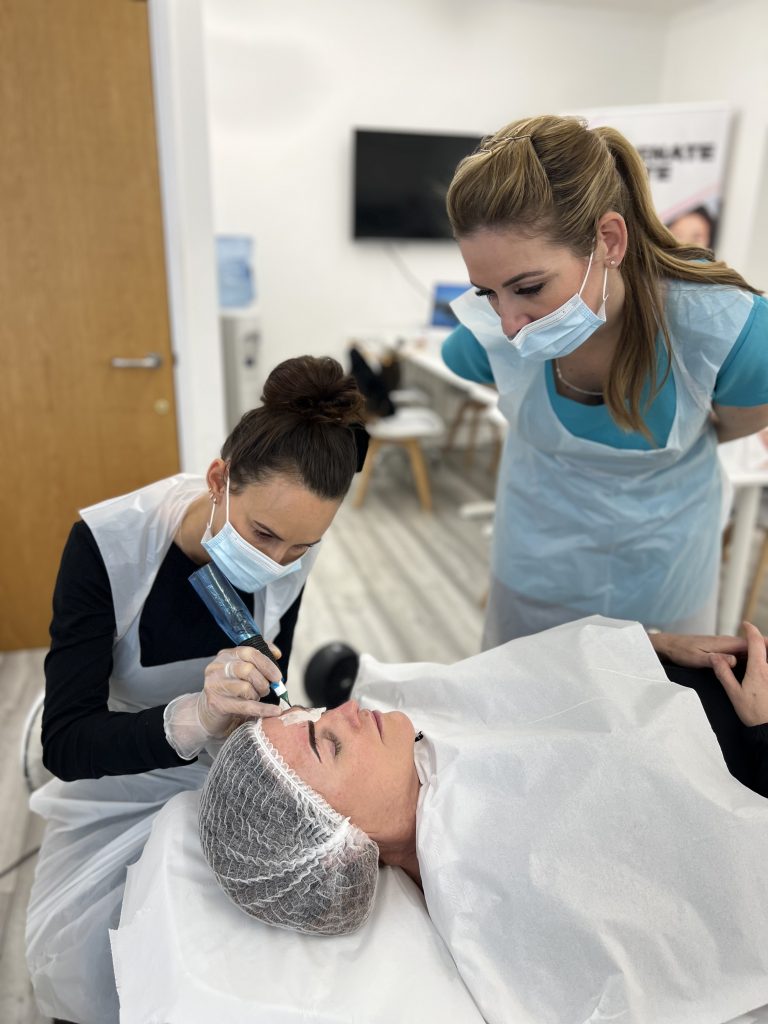
Clients do more research before booking than they used to. For example, many read reviews, ask in forums, and look for evidence that a practitioner has proper training. CQC guidance for people choosing cosmetic surgery encourages patients to ask directly about qualifications, training, expertise and experience with complications. Similarly, this expectation is spreading across the non-surgical market too.
In other words, clients want confidence. They want to feel that the person treating them knows what they are doing, has been properly trained, and understands what to do if something goes wrong. A practitioner with structured, recognised aesthetic qualifications can speak to all of those concerns with authority. Similarly, that authority matters commercially.
Aesthetic Qualifications and Practitioner Confidence
Qualifications are not just for marketing. That point is worth making clearly. Indeed, the internal benefit – depth of anatomical knowledge, structured consultation practice, understanding of contraindications and complication awareness – shapes the quality of clinical judgement practitioners bring to every appointment.
A practitioner who completes a structured qualification route covers treatment planning in depth. Moreover, they study the conditions and presentations that require referral rather than treatment. Because of this, they develop a professional framework for making decisions under uncertainty. That kind of grounding is different from the confidence that comes from a short course in a single technique.
For practitioners who want to progress into advanced treatments, that foundation matters even more. Advanced injectable techniques and combination treatment planning both require systematic knowledge. Specifically, structured aesthetic qualifications are designed to build exactly that depth.
Why Short Courses and Qualifications Serve Different Purposes
This distinction matters, because many practitioners use both – and that is entirely appropriate. Indeed, combining the two approaches at different career stages is a well-established pattern.
Short courses offer focused skills training in specific techniques. As a result, they allow practitioners to add a new treatment quickly and efficiently. A practitioner who has completed a foundation qualification and wants to add a specific advanced technique is well served by a targeted course.
In contrast, qualifications offer something broader. Structured knowledge across anatomy, consultation, safety, contraindications, and treatment planning is built in throughout. Formal assessment is included. Moreover, a level of recognition – from insurers, from the regulatory framework, and from clients – comes with a qualification that short courses do not always match.
That said, the right route depends on goals, existing background, and treatment intentions. However, many practitioners build their practice by combining both: qualifications as the professional backbone and short courses to extend their treatment range.
What QUALIFI Routes Can Support
QUALIFI is an Ofqual-regulated awarding body. As such, it offers a structured pathway of aesthetics qualifications from Level 3 through to Level 7. Each qualification builds progressively on the last.
Level 3 provides the foundation – anatomy, physiology, and an introduction to aesthetic practice. For most non-medical beginners, this is the correct starting point.
Level 4 covers advanced non-injectable skin treatments. This is the standard qualification for practitioners working with microneedling, chemical peels, dermaplaning, and cosmetic technologies.
Level 5 develops clinical skills further. It is appropriate for practitioners wanting deeper knowledge before moving into injectable practice or advanced treatment planning.
As practitioners progress further, the qualifications reflect more advanced clinical responsibility.
Level 6 covers advanced clinical competence, including complication management. This qualification demonstrates a high level of patient safety awareness and clinical responsibility.
Level 7 is the postgraduate-level injectable qualification. It is the JCCP-backed benchmark for botulinum toxin and dermal filler practice, and increasingly the standard expected by professional indemnity insurers.
In addition, GOV.UK maintains a Register of Regulated Qualifications. Practitioners can use this register to check whether a qualification holds official regulated status – a useful resource when comparing course options.
Why Credibility Matters Commercially
There is a commercial dimension to aesthetic qualifications. However, it is worth framing this clearly. No qualification guarantees a particular income level or number of clients. Nevertheless, what qualifications do support is the kind of practice a well-qualified practitioner is positioned to build.
For example, clients comparing practitioners increasingly look for markers of credibility. Qualifications are one such marker. Professional indemnity insurance is another – and most insurers require evidence of structured, accredited training. Moreover, the ability to have an authoritative, honest consultation is itself a commercial asset.
As a result, practitioners with recognised aesthetic qualifications tend to find it easier to set appropriate pricing, build referral relationships with other healthcare professionals, and position themselves in a market that is becoming more discerning. That is not a promise about income. It is a realistic assessment of how credibility functions in professional services.
How to Choose the Right Aesthetic Qualification Route
Start by asking the right questions. What treatments do you want to offer? What level are you currently at? Does your insurer require a specific qualification? Are you building towards advanced practice, including injectables?
First, consider your starting point. If you are new to aesthetics with no prior background, Level 3 is the appropriate entry point. From there, practitioners already working build towards Level 4 for advanced non-injectable skin treatments. For injectable practice, the benchmark is Level 7.
In either case, Little Beauty Academy offers guidance on the right pathway for individual circumstances. Consequently, contacting the team to discuss your specific situation before committing to a route is a useful first step.
Author: Anna Camarinha BSc
Founder and Lead Educator at Little Beauty Academy
Related Courses at Little Beauty Academy
Frequently Asked Questions
Aesthetic qualifications are structured training programmes designed to develop knowledge, practical competence and professional confidence in aesthetic practice. They typically cover anatomy and physiology, consultation skills, contraindications, treatment planning, complication awareness and safe practice. Regulated qualifications, such as those offered through QUALIFI, are quality-assured by an Ofqual-regulated awarding body and carry formal recognition from insurers and the wider professional sector.
Requirements vary by treatment type, insurer requirements, and any applicable regulatory framework. Currently, there is no single mandatory qualification requirement for all non-surgical cosmetic procedures in England. However, this is changing. The UK Government confirmed in August 2025 that a new licensing scheme requires practitioners to be suitably knowledgeable, trained and qualified. Practitioners should therefore keep up to date with current requirements as the framework develops through 2026 and beyond.
QUALIFI is an Ofqual-regulated awarding body. As a result, Ofqual-regulated qualifications appear on the GOV.UK Register of Regulated Qualifications, where practitioners can verify a qualification’s regulated status. Individual QUALIFI course details are available at Little Beauty Academy, and practitioners are encouraged to check the register at GOV.UK for specific qualification information.
The right level depends on your current experience, treatment goals, insurer requirements, and long-term plans. For most non-medical beginners, Level 3 is the entry point. From there, advancing into non-injectable skin treatments means working towards Level 4. For injectable practice, Level 7 is the benchmark. Contact Little Beauty Academy for guidance on which route suits your individual circumstances.
References
GOV.UK – Licensing of non-surgical cosmetic procedures in England consultation response (August 2025): www.gov.uk/government/consultations/licensing-of-non-surgical-cosmetic-procedures
House of Commons Library – Regulation of non-surgical cosmetic procedures in England: commonslibrary.parliament.uk/research-briefings/cbp-10331
JCCP – Competency Framework / Education and Training Register: www.jccp.org.uk
GOV.UK – Find a Regulated Qualification: www.gov.uk/find-a-regulated-qualification
CQC – Choosing Cosmetic Surgery guidance: www.cqc.org.uk